

We use cookies on this site to improve our service, perform analytics, and remember website preferences. By using this site, you consent to these cookies. For more information visit our Privacy Policy
Decision Point D and Other Changes That Will Affect Your Next FDA Submission
On May 29, 2026, the FDA issued the final “Content of Human Factors Information in Medical Device Marketing Submission” guidance, providing additional clarity from the 2022 draft guidance on when human factors validation testing is needed and expanding recommendations for submission documentation. This article details the most notable updates from the 2022 draft guidance and what they mean for future medical device marketing submissions to the FDA.
As of May 29, 2026, a final version of the “Content of Human Factors Information in Medical Device Marketing Submission – Guidance for Industry and Food and Drug Administration Staff” was issued. While this guidance is largely the same as the draft document issued in 2022, the final guidance explicitly notes a framework for documenting and deciding when human factors validation testing is needed and expands on the FDA’s documentation recommendations.
Here are some of the notable changes between the draft and final document:
- New Decision Point D in the HF Submission Category flowchart
- New expectation to explicitly state the HF Submission Category and provide rationale in Section 1 of HFE/UE report
- Prior human factors data can be used as HF Submission Category evidence
- Formalized table formats for use-related risk analysis & modified devices, with emphasis on traceability
- Additional examples and samples of HFE/UE report content
- Changes to definitions for abnormal use and use safety
- Sections 5 and 6 have switched places in the HFE/UE report outline
- Previously submitted human factors data does not need to be resubmitted (cross-referencing to prior marketing submissions is welcome)
In this article, we’ll discuss some of the significant changes to the guidance in more depth, and what these updates mean for future medical device marketing submissions to the FDA.
New Decision Point D
Decision Point D has been added into the flowchart for determining HF (Human Factors) Submission Category.
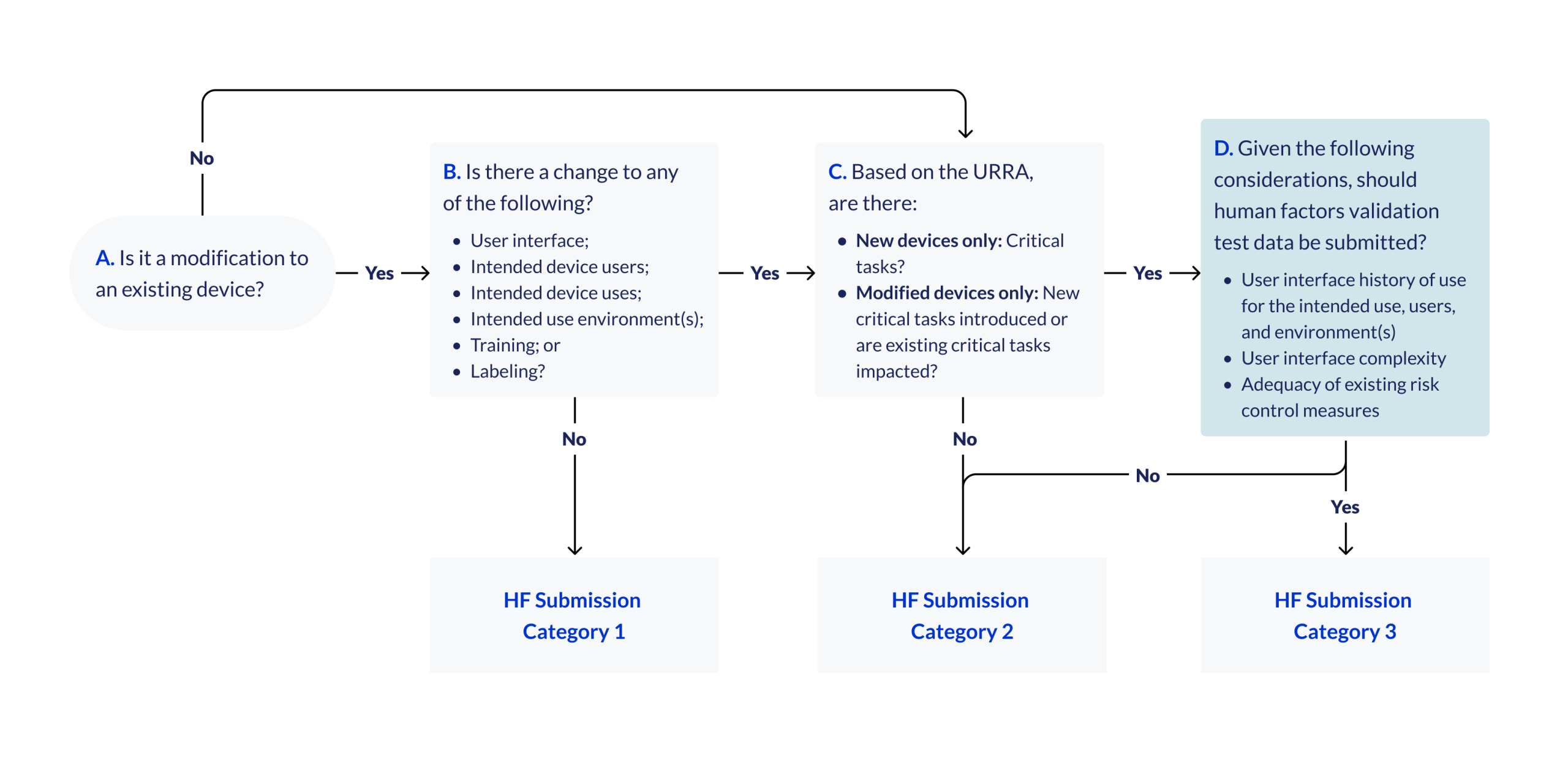
Decision Point D is an additional stage where manufacturers determine whether data from human factors validation testing should be submitted based on the use-related risk analysis and other available evidence.
Specifically, Decision Point D asks: Given the following considerations, should human factors validation test data be submitted?
Submitters are asked to assess many factors, including user interface history of use, complexity of the device user interface, and whether the existing risk control measures are adequate. For example, a simple or low complexity user interface with risk control measures that have been historically shown to have adequate risk controls may not require validation test data.
The guidance helpfully identifies specific circumstances that weigh toward HF validation testing, including:
- Complex user interfaces
- Device types associated with known use error issues (such as infusion pumps)
- Novel technological features
- Changes in indications for use or changes in use environment, in comparison to other devices of the same device type
- New recalls, adverse events, problem reports or complaints for that device type where the cause has been attributed to use error
- Increase in severity of possible harm from use error
This update reflects a more flexible, but still risk-based, process for deciding on whether HF validation testing is needed.
What does this change mean?
Greater flexibility in determining when HF validation testing data should be submitted.
In the final version of the flowchart, answering No to either Decision Point C or Decision Point D may suggest a HF Submission Category of 2 is appropriate. The new Decision Point D provides another opportunity for the manufacturer to justify not providing human factors validation testing data based on available evidence and use-related risk.
In the draft version of the flowchart, only answering No to Decision Point C led to a HF Submission Category 2. The rationale for a Category 2 submission relied on demonstrating that there were no critical tasks, no impacted critical tasks, or no new critical tasks.
This means that the presence of critical tasks and/or impacted critical tasks no longer necessarily points toward a Category 3 submission.
New Expectation to Explicitly State the HF Submission Category
Another important update to note is that the final guidance recommends that all Human Factors Engineering (HFE)/Usability Engineering (UE) reports include in Section 1 the selected HF Submission Category, the rationale supporting that category, and discussion of why the level of submitted HF information is appropriate.
Leverage previous HFE/UE evaluations when justifying Category 2
Related to the above expectation, the guidance’s new Appendix B expands on the recommended content for a Category 2 submission. Specifically, the guidance indicates that previous HFE/UE evaluations may be leveraged to support the conclusion that the device has been found to be adequately designed for the intended users, uses, and use environments (for Category 2 justification).
Sample report language is provided for two examples to demonstrate how to effectively argue a HF Submission Category 2. These arguments vary from how a device can be used by the intended users without serious use errors or problems to arguing that the user interface’s characteristics and risk control measures have been historically shown to have adequate risk controls against known use problems.
Formalized Table Formats (with Emphasis on Traceability)
The guidance provides example table formatting for the URRA (use-related risk analysis), the comparative URRA, and the comparison of a modified device user interface to the existing device. While these tables were in the 2022 draft guidance, the final guidance adds footnotes to the URRA tables that emphasizes that the user tasks should provide traceability with respect to other HF documentation.
Submitters should consider following these templates in their HFE/UE reports.
More Examples of HF Submission Category Rationales
Additional examples for how to determine the HF Submission Category have been added to section VI. Examples for A. Modifications to an existing 510(k)-cleared device and C. New Devices.
The examples for A, B, and C now illustrate how Decision Point D may affect HF Submission Category determination and specifically now include (where applicable) possible answers to Decision Point D.
Sample HFE Report Language & Content
The new Appendices A, B, and C provide sample HFE/UE Report Content for all three categories of HF Submission types and helpfully provides sample report language for the hypothetical submissions discussed in VI. Examples for Category 1 and 2. This was touched on earlier when discussing how Appendix B may assist when providing rationale for a HF Category 2.
Modified Devices Documentation
The new Appendix C provides more detailed documentation recommendations for modified devices, specifically recommending:
- a comparison of the intended users, use environments, and training (HFE Report section 2)
- a comparison of the subject device user interface to that of the existing device (HFE Report section 3)
- identifying the elements of the device user interface components, including labeling, that were modified (HFE Report section 3)
- a comparative URRA, discussion of whether the risk associated with the modification is acceptable, and whether the proposed changes warranted human factors validation testing (HFE Report section 6).
These recommendations move modified-device submissions toward a more structured comparative assessment of users, interfaces, risks, and control measures.
Practical Impact for Submitters
In summary, as far as changes that impact submitters, the final guidance:
Expanded pathway for justifying Category 2 submissions based on risk.
Provides more explicit explanation for when Category 3 HF validation testing is expected.
Provides expanded examples, table formats, and report templates that can be used when determining HF Submission Category, evaluating critical tasks, and documenting the rationale supporting a submission.
The guidance itself has not changed fundamentally, rather it has been revised to provide a clearer framework. Decision Point D, expanded examples, sample report language, and additional documentation recommendations can help manufacturers better justify the amount of human factors evidence included in a submission, particularly for modifications to existing devices.
About HHF’s Evaluation & Regulatory Services
Our team works with healthcare organizations, including the top 10 medical device companies in the world, to ensure products are safe and effective for intended users, uses and use environments. We have extensive experience with FDA, European, and international usability requirements and can tailor our services specifically to your needs.