

We use cookies on this site to improve our service, perform analytics, and remember website preferences. By using this site, you consent to these cookies. For more information visit our Privacy Policy
Optimizing Serious Illness Conversations
HHF facilitated a collaborative process with clinical and research teams across UHN to reimagine how serious illness conversations are prepared for, conducted, and documented. Our design process produced actionable recommendations to support clinicians in providing better experiences for patients and providers around critical and often life-changing conversations.
Client
UHN Research team: Dr. Karen Okrainec, Richard Dunbar-Yaffe, Isabelle Caven and Warren Lewin
Services
Human-Centred Research, Co-Design Workshops, Service Design, Clinical Workflow Design
Opportunity
Serious illness conversations are moments when care teams deliver critical information to patients and families around prognosis, treatment options, and planning for next steps. Although they are critical moments in care, they are often inconsistently managed and rushed and can be very difficult for both patients and providers. A collaborative team of researchers and clinicians at University Health Network (UHN) had identified a number of challenges present in General Internal Medicine wards, which led them to engage our team at Healthcare Human Factors (HHF) to co-create interventions through our expertise in human-centred design practices. The key challenges we set out to address through this work were:
- Patients and families often feel unprepared and overwhelmed, and are unsure of what to expect.
- Clinicians, often learners, lack the time and support needed to confidently lead these conversations.
- Documentation can be fragmented within EHR systems, making it difficult to ensure patient values are consistently understood and carried forward across care teams.
Our team worked with the UHN research and clinical teams to identify the root cause of these challenges and explore opportunities to shift serious illness conversations from a single high-pressure event to an ongoing, human-centred process, producing concrete recommendations and action items that the hospital could put into practice.
Process
The UHN research team engaged patients, caregivers, and clinicians through interviews to build a foundational understanding of the current experience. We then invited all of these groups to join a collaborative exploratory workshop to deepen our understanding of this research. Participants were asked to share what they wanted and needed before, during, and after serious illness conversations, highlighting gaps at each stage.
What We Discovered
Patients shared that they want more time, guidance, and emotional support to feel better prepared for conversations.
Clinicians identified a need for tools and structured training to lead conversations effectively.
Patients shared that conversations seemed to be more effective when they were ongoing rather than one-time events.
Clinicians identified that documentation practices need to be improved across care teams to ensure appropriate follow-up can occur.
Guiding Principles
Insights from patients, caregivers, and clinicians shaped a set of guiding principles that anchored the work through all phases. Serious illness conversations should be:
Clear
Use simple, descriptive language so patients and families can understand what conversations mean for them.
Compassionate
Create space for emotion and time for reflection to build trust during difficult conversations.
Informed
Ensure both patients and providers have the knowledge they need to participate meaningfully.
Reciprocal
Support two-way conversations where patients and their families can actively contribute.
Ongoing
Recognize that serious illness conversations evolve over time and require multiple touchpoints.
Patients, caregivers, clinicians, and administrators were then invited to join two additional workshops where we iteratively explored the identified challenges, prioritized opportunities, and generated ideas. Participants worked together to co-design a journey and associated resources, which was then refined and validated to to ensure it was grounded in clinical realities.
The Solution
A redesigned conversation journey
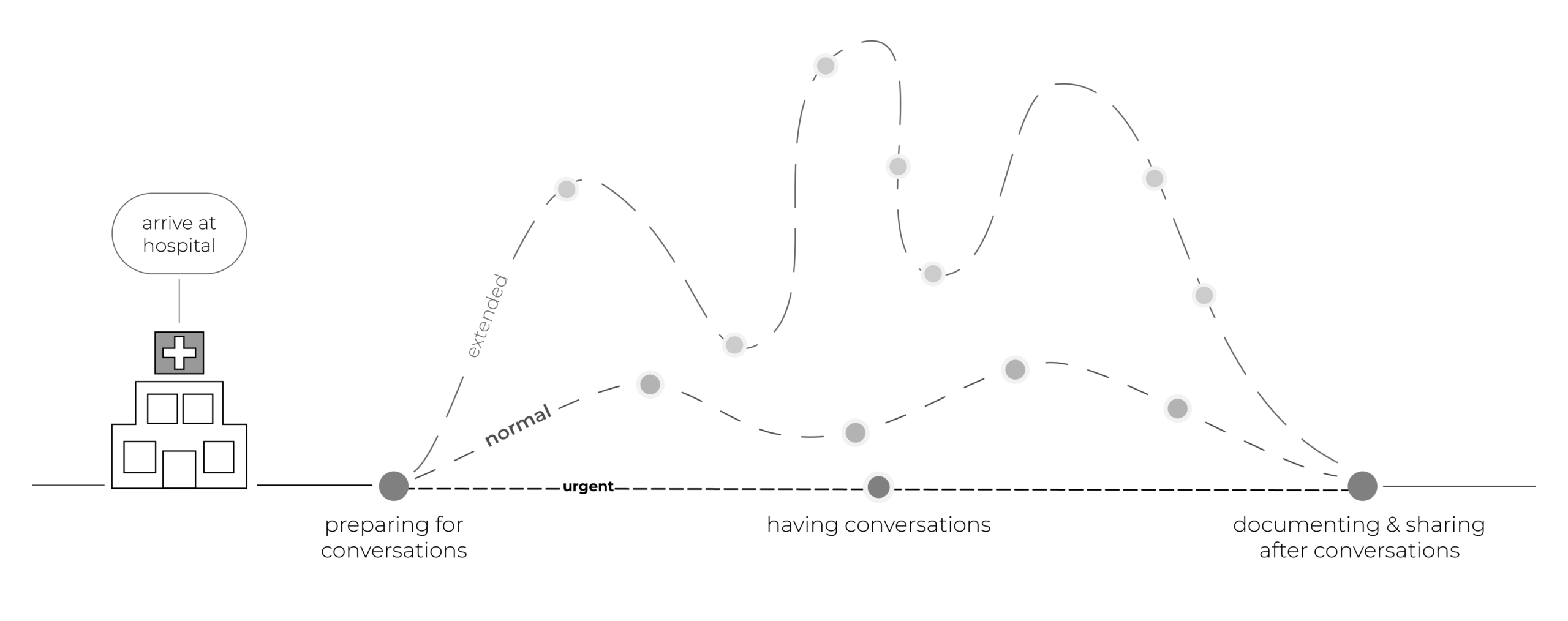
We developed an ideal serious illness conversation journey structured around three phases:
- Preparing for Conversations – Patients and providers are supported with tools and resources to understand the purpose of the conversation and reflect on their values, goals, and fears.
- Having Conversations – Conversations are flexible and cumulative, allowing time for multiple perspectives and adaptation based on urgency and patient needs.
- Documenting and Sharing after Conversations – Clear and collaborative documentation ensures that patient values and decisions are accessibly documented and able to be shared across the full care team.
Key Design Components
To support this journey, four foundational elements were proposed:
- Patient-centred resources to guide reflection and preparation
- Flexible conversation pathways that adapt to urgency and complexity
- Goals of Care facilitation to support clinicians and coordinate conversations
- Collaborative documentation to create a shared and consistent record of decisions
Outcomes
This work resulted in a clear, actionable vision for improving serious illness conversations across clinical settings.
Together we achieved:
- A shared, patient-centred framework for how conversations should occur
- Practical tools and concepts to support both patients and providers
- Alignment across stakeholders on the importance of clarity, compassion, and continuity
- A scalable model that supports both immediate improvements and long-term cultural change
The design process and implications of this work for UHN’s General Internal Medicine department were published in a paper, presenting a framework for other hospitals to follow as they lead their own quality improvement initiatives around serious illness conversations.
Engaging HHF’s design team allowed the UHN research and clinical teams to more deeply understand the challenges they had uncovered and work towards a solution that centred the needs of all people involved in serious illness conversations.